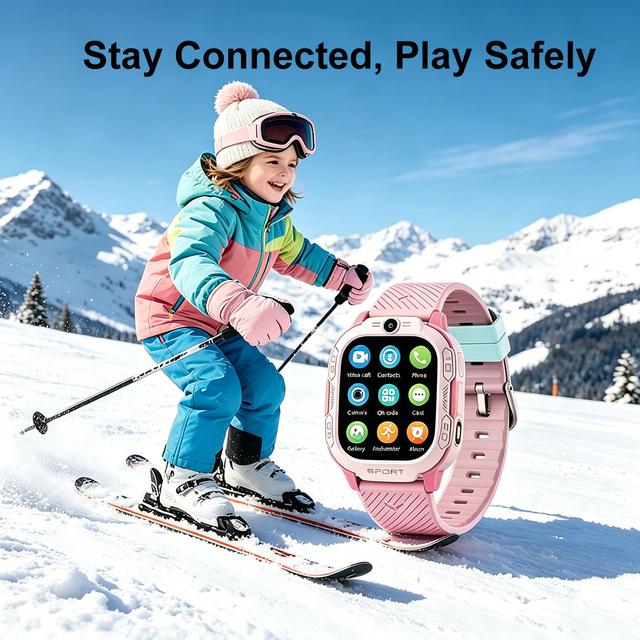
A Kids GPS Tracker Watch may calculate or record a location without an active SIM, but that does not mean every tracking and communication function will work. GPS receives satellite signals; it does not send the result to a parent's phone. Remote live tracking normally needs a data path, such as cellular service or supported Wi-Fi. Calls, messages, SOS notifications, geofence alerts, and app synchronization may also depend on that connection. The useful answer is therefore conditional: some watches can perform limited local or Wi-Fi functions without a SIM, while a standalone school safety watch usually needs compatible connectivity for full remote operation.
Key Takeaways
GPS can determine a position without a SIM, but sharing that position remotely requires connectivity.
Wi-Fi may support selected functions, yet coverage, login requirements, and model design limit its reliability as a complete cellular replacement.
Voice calls, mobile data, SOS alerts, geofence notifications, and live app updates often require an active SIM or eSIM plan.
Buyers must confirm supported bands, SIM type, carrier rules, data usage, app/server access, and fallback behavior for the exact model.
GPS and SIM Cards Perform Different Jobs
GPS is a receiving technology. The watch listens for signals from navigation satellites and uses timing information to estimate its position. It does not need a SIM merely to receive those signals. However, the watch must transmit coordinates if a parent wants to see them on a remote app. That transmission requires a communication channel.
A SIM identifies the device to a mobile network and enables services allowed by the plan and hardware. Depending on the product, those services may include mobile data, voice calls, SMS, or some combination. An eSIM performs a similar identity function through embedded hardware and digital provisioning rather than a removable card. Neither a physical SIM nor an eSIM improves satellite reception by itself; it provides network access.
This distinction explains why “GPS watch without cellular service” can mean several different things. It may describe a watch that records a route for later download, a Bluetooth accessory that depends on a nearby phone, a Wi-Fi-only device, or a watch with inactive cellular hardware. These products do not provide the same experience as a standalone connected child tracker.
What Can Work Without an Active SIM?
Basic local functions may continue without a SIM. The watch may show time, count steps, use an alarm, operate certain offline tools, or acquire GPS coordinates. Whether it stores a route depends on its software and memory. Some devices can connect to a known Wi-Fi network for data functions, while others use Wi-Fi only as a positioning aid and still require cellular service to communicate.
Bluetooth models may pair with a nearby phone, but that arrangement is less useful for a child who does not carry a phone. The watch loses its data path when it moves out of Bluetooth range. A device designed for sports may log a route offline and synchronize later, but delayed history is not the same as a guardian seeing the child's current location.
The D35Wifi 4G kids GPS watch is designed with both cellular and manual Wi-Fi connectivity. Its product information describes operation over Wi-Fi in areas with poor cellular coverage and GPS, Wi-Fi, and LBS positioning. Buyers should verify precisely which app, calling, alert, and tracking functions remain available over Wi-Fi and which depend on the selected SIM service.
What Usually Stops Without Cellular Service?
Remote live location is the first major limitation. The watch may know its coordinates, but the guardian app cannot receive them unless the device has internet access. Location refresh, route upload, battery status, remote settings, and device commands may remain outdated until Wi-Fi or cellular data returns.
Voice calling may stop if the watch uses ordinary mobile voice service. Some products use internet calling, which could work over compatible Wi-Fi, but this must be explicitly supported. SMS alerts require mobile messaging service. Video calls need a data connection and typically use more bandwidth and battery than location updates.
SOS behavior is especially important. Pressing the button may start a cellular call, send an SMS, upload a notification through mobile data, or perform several actions. Without the required service, the watch might only display a local indication. Families must test SOS in the actual no-SIM or no-coverage condition rather than assuming the label guarantees remote delivery.
Geofence alerts also depend on data flow. A watch can detect or estimate a transition locally, but the parent will not receive a timely notification unless that event reaches the server or app. Remote shutdown, restart, contact updates, and school-mode schedules may likewise depend on synchronization.
Can Wi-Fi Replace a SIM?
Wi-Fi can replace cellular data for some functions on a watch specifically designed to use it. At home, a caregiver's house, or another trusted network, it may allow the device to synchronize, support app communication, or improve indoor positioning. It can also reduce mobile data consumption.
However, Wi-Fi is location-bound. A child walking between home and school will move through gaps. School networks may require a browser-based sign-in, certificates, or user credentials that a watch cannot handle. Administrators may block personal devices. Public Wi-Fi introduces additional privacy and reliability concerns and should not be treated as a dependable emergency channel.
Wi-Fi positioning and Wi-Fi connectivity are also different. A device may scan nearby network identifiers to estimate location without joining those networks. That does not give it internet access. Product literature should explain whether “Wi-Fi” means positioning assistance, manual network connection, automatic connection, or all of these.
A Wi-Fi kids GPS watch can be useful where cellular coverage is poor but known networks are available. It is not automatically a subscription-free kids tracker with full service everywhere. Server access, app use, calling method, and network management may still create service requirements even when a SIM is absent.
Physical SIM, eSIM, and No-SIM Options
A removable physical SIM is familiar and allows replacement, but the watch must support the card size, carrier, bands, network technology, and plan settings. Some carriers restrict wearable use or require activation in an approved device. Automatic configuration is not guaranteed; the watch may need correct access-point settings.
An eSIM removes the physical card slot and can simplify sealing or provisioning, but it depends on the watch platform and carrier support. A product that has eSIM hardware is not necessarily compatible with every eSIM provider. Provisioning, transfer, roaming, cancellation, and account ownership should be confirmed for the target market.
A no-SIM device may rely on Wi-Fi, Bluetooth, a proprietary low-power network, or offline logging. This can reduce one recurring mobile charge, but it often reduces coverage or immediacy. Buyers should compare the total system rather than viewing the absence of a SIM as an unconditional advantage.
For B2B deployment, the decision affects fulfillment and support. A bundled service may make activation easier but creates regional and contractual obligations. An unlocked watch gives distributors more carrier choice but requires a clear compatibility matrix and setup instructions. Device samples should be tested with representative carriers before a volume order.
A Function-by-Connection Comparison
Function
GPS only
Known Wi-Fi, if supported
Active cellular service
Calculate outdoor position
Usually possible
Possible; Wi-Fi may assist
Possible
Show live position in parent app
No remote update
Possible while connected
Generally possible within coverage
Upload route history
Delayed or unavailable
Possible while connected
Generally possible
Voice call
Usually unavailable
Only if internet calling is supported
Possible with a compatible voice service
SMS
Unavailable
Unavailable as ordinary SMS
Possible with an SMS-enabled plan
Video call
Unavailable
Possible on supported models
Possible with sufficient mobile data
SOS alert
Local action only unless another path exists
Possible if the SOS method uses data
Possible when plan, signal, and configuration support it
Geofence notification
Not delivered remotely
Possible while connected
Generally possible within coverage
Remote settings
Unavailable until synchronization
Possible while connected
Generally possible within coverage
“Possible” is not a product guarantee. Firmware, app design, server configuration, plan restrictions, and regional networks determine actual behavior. The children's GPS tracking solution describes a connected system combining devices, cellular service, an app, multi-source positioning, SOS, voice calls, geofencing, and class mode. Confirm the intended configuration rather than separating the watch from its service environment.
Questions to Ask Before Choosing a SIM Plan
Start with network compatibility. Which LTE bands and fallback technologies does the exact model support? Which carriers have been tested in the target country? Does the carrier allow the device type and required voice, SMS, and data services? Is roaming required for travel or border regions?
Then examine service consumption. Location update frequency, route uploads, voice messages, and video calls use different amounts of data and power. A low-cost plan may be sufficient for periodic tracking but inadequate for frequent video communication. The plan must also remain active; an expired balance can silently remove remote functions.
Ask how the app and server are provided. Is access included, time-limited, region-specific, or tied to a reseller? Can more than one guardian use the app? What happens when the watch changes owner? How are firmware and configuration updates delivered?
Finally, inspect setup and recovery. Who installs the SIM? Are PIN locks supported or required? How are APN settings entered? Can the watch show signal status? What alert appears when the SIM is missing, data is unavailable, or the account is inactive? Clear diagnostics reduce support calls and help families recognize a connectivity problem before an emergency.
How to Test a Watch Before School Use
Test in stages. First, power the watch without a SIM and record which local functions remain. Next, connect it to a known Wi-Fi network and check app synchronization, position updates, calls, messages, SOS, and remote controls individually. Then activate a compatible SIM and repeat the same test outdoors, indoors, and along the normal commute.
Do not test only beside the guardian's phone. Walk beyond Bluetooth range and away from home Wi-Fi. Observe how quickly the app shows a loss of connectivity and how it labels the last known location. Trigger a safe-zone transition, change a contact, and adjust class mode to see when remote settings synchronize.
Run a controlled SOS drill with all participants informed. Confirm who receives the alert, which channel is used, what location and timestamp appear, and what happens when the first contact does not answer. Repeat the test with mobile data disabled and with Wi-Fi available so the family understands fallback behavior.
Battery testing should use the intended configuration. Weak cellular coverage can increase power consumption as the watch searches for service. Frequent Wi-Fi scanning and short location intervals also consume energy. A configuration that works technically may still be impractical if it cannot last through the school day.
Common Misunderstandings About SIM-Free Tracking
The first misunderstanding is that GPS itself sends data. It does not. The second is that every Wi-Fi-capable watch can make internet calls. Wi-Fi may be used only for location assistance. The third is that “no subscription” means no service dependency; an app or server may still be required even if there is no monthly cellular plan.
Another mistake is buying any inexpensive SIM with enough data. The watch may also need voice or SMS, and it must support the carrier's bands and activation rules. Some plans designed for phones or tablets may not work correctly in a wearable.
Offline route logging is sometimes presented as live tracking. It can be useful for reviewing a journey later, but it cannot provide immediate reassurance or deliver an emergency alert. Similarly, a last-known location is historical information, not proof that the child is still there.
4P-Touch provides a Kids GPS Tracker Watch product category for comparing device types. Confirm cellular, Wi-Fi, voice, positioning, and service details on the selected model because functions can vary across a range.
Conclusion
A kids GPS watch can perform limited tasks without a SIM, and GPS positioning itself does not require one. Full remote tracking is different: the watch needs a reliable channel to send its location and receive commands. Wi-Fi can support selected functions in known coverage, but it rarely provides continuous school-route connectivity. For most standalone safety use, a compatible cellular plan remains the practical foundation for calls, alerts, and live app updates. 4P-Touch offers connected watch options, yet buyers should verify the exact model, bands, SIM or eSIM requirements, server arrangement, and no-coverage behavior in the target market.
FAQs
Can a Kids GPS Tracker Watch locate a child without a SIM?
It may calculate or store a position locally, but a parent cannot receive a live remote update unless the watch has another supported data connection, such as compatible Wi-Fi.
Does GPS use mobile data?
Receiving satellite signals does not use mobile data. Sending coordinates to an app, downloading map-related information, synchronizing history, or receiving remote commands can use data.
Can SOS work over Wi-Fi?
Only when the watch and its service are designed to send SOS notifications or internet calls over Wi-Fi. If SOS relies on cellular voice or SMS, it will require compatible mobile service.
Can I use a phone SIM in a kids smartwatch?
Possibly, but only if the card size, network bands, plan type, voice/SMS/data services, carrier policies, and APN settings are compatible. Confirmation and sample testing are essential.
Is eSIM better than a physical SIM for children?
Neither is universally better. eSIM can simplify sealing and remote provisioning, while a physical SIM can be easier to replace. Carrier availability, activation, roaming, support, and ownership determine the better option.
Will the watch still show time when the plan expires?
Basic local functions may continue, but remote tracking, calls, messages, alerts, and synchronization may stop. Exact behavior varies by model and should be tested before relying on the device.