When parents choose a kids GPS tracker, accuracy is often one of their biggest concerns because it directly affects how useful the device will be in everyday life. A reliable location reading can help families monitor school commutes, check whether a child has arrived safely, and respond more quickly in unexpected situations. In emergency scenarios, accurate tracking can be especially important because even small location errors may affect how fast parents can react. However, while kids GPS trackers can provide accurate and helpful location data, their real-life performance often depends on where the child is and how the device is being used, since signal conditions, surroundings, and tracking technology can all influence the final result.
1.The Short Answer: Accuracy Depends
No Single Accuracy Standard
There is no single accuracy level that applies to every kids GPS tracker, because performance can vary widely from one device to another. Some products are designed with stronger hardware and more advanced positioning systems, while others offer more basic tracking functions. As a result, two devices may both be described as kids GPS trackers, but their real-world performance can still be quite different.
Outdoor Tracking Is Usually More Accurate
In general, outdoor GPS tracking is usually much more accurate than indoor positioning. When a child is in an open area such as a playground, school yard, park, or roadside, the device can receive stronger satellite signals and provide a more precise location. This is why parents often find that tracking works better during outdoor movement than inside buildings.
Indoor Accuracy Is Often Less Precise
Indoor environments are usually more challenging for location tracking. Walls, roofs, and other obstacles can block or weaken GPS signals, which makes it harder for the device to provide an exact position. In these situations, the tracker may switch to Wi-Fi or cellular-based positioning, which helps keep the child’s location visible but may not be as precise as outdoor GPS.
Several Factors Affect Performance
In real use, accuracy depends on several factors working together, including device hardware, signal conditions, and the positioning technology built into the product. Network quality, nearby buildings, weather conditions, and even how often the location updates can influence the final result. For this reason, kids GPS trackers can be very helpful, but their performance should always be understood in the context of where and how they are being used.
 2.What Affects the Accuracy of a Kids GPS Tracker?
Positioning Technology
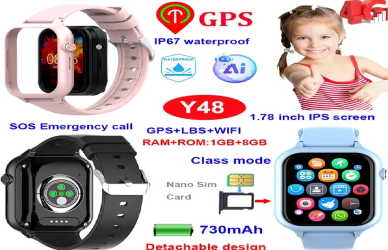
One of the biggest factors affecting the accuracy of a kids GPS tracker is the positioning technology it uses. Most devices rely on a combination of GPS, Wi-Fi, and LBS or cellular positioning. GPS is usually the most accurate option in outdoor environments because it connects to satellite signals and can provide more precise location data in open areas. Wi-Fi positioning is often used when a child is indoors or near known wireless networks, while LBS uses nearby cellular towers to estimate location when GPS signals are weak or unavailable. Because of this, Wi-Fi and LBS are often helpful backup methods, but they are usually less precise than GPS.
Environment
The surrounding environment also has a strong effect on tracking accuracy. In open outdoor areas such as parks, playgrounds, or school entrances, GPS signals are usually stronger, which helps the device provide more accurate positioning. However, buildings, trees, bridges, tunnels, and dense urban areas can block or weaken satellite signals and reduce GPS performance. Indoor positioning is often less precise than outdoor tracking for the same reason, since walls and other structures make it harder for the device to maintain a strong GPS connection.
Update Frequency
Accuracy is not only about how exact the location looks on the map, but also about how often the tracker refreshes that location. A device with frequent updates can give parents a more realistic view of a child’s movement in real time. By contrast, a tracker with long update intervals may appear less reliable, even if its positioning technology is good, because the child may have already moved before the next location update appears. In daily use, this can make the tracker feel slower or less accurate than it actually is.
Device and App Quality
The quality of the device and its companion app can also influence overall tracking performance. Better hardware and software usually improve location stability and reduce errors in daily use. A well-designed app may also help by filtering out less accurate Wi-Fi or LBS points from route history, which can reduce false jumps or sudden location changes on the map. As a result, a kids GPS tracker is not judged only by its positioning method, but also by how well the device and app work together to present clear and reliable location information.
3.What Accuracy Can Parents Realistically Expect?
In good open-sky conditions, GPS-enabled kids trackers are often accurate within a few meters, which is usually enough for parents to monitor daily movement, school commutes, and outdoor activities with reasonable confidence. However, real-life accuracy can drop when a child is indoors, near tall buildings, or in crowded urban areas where signals are weaker or blocked. For this reason, many kid-focused trackers use a combination of GPS, Wi-Fi, and LBS positioning to keep location available even when GPS alone is not enough. While this mixed approach helps maintain tracking continuity, parents should understand that indoor or backup positioning may be less precise than outdoor GPS, so the most realistic expectation is stable everyday tracking rather than perfect map accuracy in every situation.
4.How to Improve Accuracy in Daily Use
Choose a Device with Multiple Positioning Methods
Parents can improve tracking performance by choosing a device that supports GPS, Wi-Fi, and LBS. This combination helps maintain location tracking in different environments. GPS works better outdoors, while Wi-Fi and LBS can support positioning when signals are weak or the child is indoors.
Check the Location Update Frequency
It is also important to check whether the tracker offers faster location updates. Shorter refresh intervals can provide a more timely and realistic view of a child’s movement, which makes the tracker feel more reliable in daily use.
Use a Network with Strong Local Coverage
Using a carrier or network with good local coverage can also improve tracking quality. A stronger signal can improve location stability and reduce positioning errors, especially during commutes or in areas with weaker coverage.
Review the App Settings
Parents should also review app settings such as route filtering or location refresh options. These features can reduce false jumps on the map and make tracking results appear more stable and reliable.
5.Why Location Sometimes Looks Wrong
Small Map Shifts Can Happen in Daily Use
A child’s location may sometimes appear to jump across the street or drift slightly on the map, which can make the tracker seem less accurate than expected. In real use, this usually happens because the device is working under changing signal conditions rather than tracking from one perfect source all the time.
Signal and Update Limits Affect the Result
Weak GPS signals, fallback positioning through Wi-Fi or LBS, and longer refresh intervals can all cause this effect. For example, when a child moves between outdoor and indoor areas or passes through places with signal interference, the tracker may briefly show a less precise position on the map.
Occasional Drift Does Not Always Mean a Problem
In most cases, occasional map drift does not mean the tracker is defective. It is often a normal result of how real-world positioning technology works in different environments.
6.How to Judge Accuracy Before Buying
Look at Real-World Reviews
Before buying a kids GPS tracker, it is important to read real-world reviews instead of relying only on spec-sheet claims. Product descriptions often highlight ideal performance, while user reviews can show how the tracker works in daily situations such as school commutes, outdoor play, and indoor use. Reviews can also reveal whether the device performs consistently over time, whether the app is easy to use, and whether parents are satisfied with alerts and location history. This kind of feedback is often more helpful than marketing language alone.
Compare Everyday Performance
Parents should also compare update intervals, geofencing behavior, and route history performance. A device may sound accurate in theory, but its real value depends on how often it updates location and how consistently it reports movement during normal daily use. It is also useful to check whether geofence alerts arrive on time and whether route history looks clear and believable rather than incomplete or confusing. These details can make a big difference in real family use.
Focus on Stable Tracking
Most importantly, buyers should focus on stable everyday tracking rather than only looking at the highest advertised accuracy numbers. In real life, a tracker that performs consistently across different environments is usually more useful than one that promises perfect accuracy under ideal conditions. For most parents, a practical device with reliable updates, steady app performance, and reasonable location accuracy will provide more value than a product that sounds impressive on paper but performs unevenly in everyday situations.
FAQ
1. Are kids GPS trackers accurate indoors?
Indoor accuracy is usually lower than outdoor accuracy because GPS signals are weaker inside buildings, so devices often rely more on Wi-Fi or LBS positioning.
2. Why does my child’s GPS location sometimes jump on the map?
Map drift can happen when signals are blocked or when the device switches between GPS, Wi-Fi, and cellular-based positioning. Longer refresh intervals can make this look worse.
3. How often should a kids GPS tracker update location?
For stronger real-time use, shorter update intervals are generally better. Some reviewers recommend updates of 60 seconds or less for easier tracking in emergencies.
4. Are geofence alerts always instant?
Not always. On some devices, geofence alerts follow the location update schedule,
Conclusion
In conclusion, kids GPS trackers can be highly useful for everyday family safety, but their accuracy is not always the same in every situation. Real-life performance can change depending on the environment, the positioning technology used, and how often the device updates location. Open outdoor areas usually allow better tracking, while indoor spaces or crowded urban settings may reduce precision. For this reason, the best kids GPS tracker is not simply the one with the highest advertised accuracy, but the one that combines stable positioning, practical alerts, and reliable app performance for daily family use. As a professional manufacturer in this field, Shenzhen Yushengchang Technology Co., Ltd. focuses on providing kids GPS tracker solutions designed to support more dependable tracking and practical family safety needs.